Time for a new definition:
Query: Method used to request information from a database (Jessup, Valacich, and Wade 419)
If I know how to transmit a query to my DBMS, I have almost endless amounts of information at my fingertips!
So how would I transmit my queries? There are two common ways:
- Query by Example (QBE): A capability of a DBMS that enables data to be requested by providing a sample or a description of the types of data we would like to see. (Jessup, Valacich, and Wade 419)
- Structured Query Language (SQL): The most common language used to interface with databases (Jessup, Valacich, and Wade 421)
Learning SQL gives me power, because it is a language I can then use to customize and tailor my queries to suit exactly my needs.
SQL: An Incredibly Awesome Tool
SQL is a fourth generation language (4GL): A computer language commonly used to write and execute queries of a database (Jessup, Valacich and Wade 79)
4GLs are also known as outcome-oriented languages, because they are designed with a focus on the desired outcome (retrieving specific information from databases) rather than the required steps to achieve the desired outcome. These languages are more intuitively similar to English, making the learning of them fairly easy.
So here I go, trying to learn basic SQL.Basic SQL:
SQL can be broken down into 2 purposes:
- Data Manipulation Language (DML): These are query and command commands
- Data Definition Language (DDL): These commands seek to create, or delete the tables that the database uses to store the data, edit the tables' primary and foreign keys and define constraints between tables.
Here are the following basic comands:
 For tutorials on SQL syntax, go here and here.
References:
Jessup, Leonard M., Joseph S. Valacich, and Michael R. Wade. Information Systems Today: Why IS Matters. 2nd ed. Toronto: Pearson Prentice Hall, 2008.
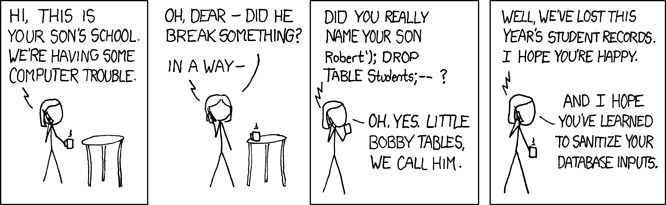
xkcd.com/327/ . 6 Apr 2009
"SQL." en.wikipedia.org. 03 Apr 2009. 6 Apr 2009


No comments:
Post a Comment